 Create Future Gaming 2023-1-ES01-KA210-SCH-000150686
Topic outline
-
-
Forum
-
-
Course Title:
"Gamification Strategies for Primary Education: A Multicultural Approach"
Course Description:
This course aims to empower primary school teachers from Spain, Romania, Turkey, and the Czech Republic with the skills and knowledge to effectively incorporate gamification techniques into their teaching methods. The course will explore cultural considerations and offer practical tools to create engaging and educational experiences for young learners.
Course Modules:
Introduction to Gamification in Education-May 2024
- Definition and principles of gamification.
- Benefits of gamification in primary education.
- Case studies of successful gamification in different countries.
Understanding Cultural Contexts-May 2024
- Overview of primary education systems in Spain, Romania, Turkey, and the Czech Republic.
- Cultural considerations in gamification.
- Adapting gamification strategies to diverse classrooms.
Game Design Fundamentals for Educators May 2024
- Elements of game design: rules, goals, feedback systems.
- Balancing educational content with play.
- Creating inclusive and accessible games.
Digital and Non-Digital Gamification Techniques May 2024
- Leveraging technology in gamification.
- Traditional games and activities for classrooms without digital resources.
- Blending digital and non-digital methods.
Creating a Gamified Curriculum- June 2024
- Integrating gamification with existing curricula.
- Designing gamified lesson plans and activities.
- Assessing student engagement and learning outcomes.
Workshop: Developing Your Gamified Lesson Plan-June 2024
- Hands-on session for teachers to create their own gamified lesson plan.
- Peer reviews and feedback from instructors.
Challenges and Best Practices June 2024
- Addressing common challenges in implementing gamification.
- Sharing best practices and lessons learned.
- Ensuring ethical and educational appropriateness.
Final Project: Implementing a Gamified Lesson June 2024
- Teachers implement a gamified lesson in their classroom.
- Submission of a reflective report on the experience and student feedback.
Community and Collaboration June 2024
- Building a network of educators for ongoing support and idea exchange.
- Collaborative projects and cross-cultural exchanges between participating countries.
Course Duration:
8 Weeks (including the final project implementation)
Course Materials:
- Interactive online modules
- Downloadable resources and templates
- Access to a community forum for discussions and support
Assessment and Certification:
-
-
1. INTRODUCTION
One specific goal that behavioural scientists have in helping people attain better outcomes is to design interventions that get people engaged in activities such that their likelihood of completion is increased. In the world of “nudging” these interven- tions take the form of small changes in context that might have large outcomes. In addition, the effects of nudging can often be complemented with interventions that are longer lasting in nature – interventions that increase longer term adherence to a task at hand. In this report, we focus on one such set of interventions collectively known as gamification.
Motivation and engagement are usually considered prerequisites for the completion of a task or encouragement of a specific behaviour. In education, the reasons for drop-outs or low performance include boredom or lack of engagement, a pattern of escalating absenteeism where each absence makes the person less willing to re- turn to school, and most importantly, being distracted by technology such as smartphones and the Internet.1 Employee training programs face similar challenges, due to minimal interest and attention.2 This situation is usually acerbated by compre- hension issues and group hostilities that lead to stress and unhappiness, which in turn hinder absorption of information and the effectiveness of training programs.3
In today’s digital generation gamification has become a popular tactic to
encourage specific behaviours, and increase motivation and engagement. Though com- monly found in marketing strategies, it is now being implemented in many educa- tional programs as well, helping educators find the balance between achieving their objectives and catering to evolving student needs.
The intent of this workshop is to define gamification, deconstruct the process of gamify- ing a learning program, explore the limitations, and review successful implementa- tions of gamification. We focus on learning programs in this report for several reasons. They key reason, though, is that we see education initiatives as a good companion to nudging programs in many areas of welfare (e.g., financial literacy, health education, consumer learning, disclosures) and hence a key challenge for policymakers as well as those on the ground delivering these programs. However, as the reader will discern, the framework we have developed for gamification of education is fertile and can be extended easily to other domains where interventions to increase engagement and retention are desired.
-
. WHAT IS GAMIFICATION
“Fun can obviously change behaviour for the better”4 is the statement that surrounds The Fun Theory initiative by German automotive company, Volkswagen. Whether it is encouraging drivers to buckle their seat belts or citizens to recycle and lower the rates of littering, Volkswagen puts a twist on these mundane tasks to make it fun.
One of their initiatives that went viral, was the Piano Staircase at the Odenplan sub- way in Stockholm, Sweden. Each step of a staircase in the subway was setup to play a musical note when it was stepped on. At the end of the campaign, the results showed that 66% more people used the musical stairs over the escalator.5 This is a prime example of gamification, and is a common tactic that companies are using in their marketing strategies.
A quick look at the video game industry over the past few years shows explosive growth as a result of increased access to Internet and smartphones. According to ESA’s 2013 Essential Facts about the Computer and Video Game Industry, 58% of Americans play video games, spending a total of $20.77 billion dollars in 2012. 6 Gam- ers have a distinct characteristic where they strive to be on the verge of what Jane McGonigal mentions as an ‘epic win’ during her TED Talk in 2010. These gamers have four common factors: urgent optimism, social fabric, blissful productivity, epic mean- ing, and that ultimately makes them super empowered hopeful individuals. 7
In real life, individuals do not feel that they are as good as they are in games. When confronted with obstacles, people may feel depressed, overwhelmed, frustrated or cynical; feelings that are not present in the gaming environment. They also prefer in- stant gratification to keep themselves engaged and motivated. And this, is where gamification steps in. In fact, gamification guru, Yu-kai Chou defines gamification as “the craft of deriving all the fun and addicting elements found in games and apply- ing them to real-world or productive activities”, while Ray Wang, CEO & Principal An- alyst of Constellation Research, Inc., describes it as a “series of design principles, pro- cesses and systems used to influence, engage and motivate individuals, groups and communities to drive behaviours and effect desired outcomes.”8
“You create these communities around the game that do an incredible amount of intellectual work, and when they’re done with the work, they will leave the game and go to another game that’s more challenging. Can you imagine if we had that kind of environment in classrooms?”
– Constance Steinkuehler Squire
Associate Professor in digital media at the University of Wisconsin-Madison
-
3. APPLYING GAMIFICATION IN EDUCATION
While the concept of gamification may be simple, effectively gamifying a concept isn’t. However, it can be simplified, by following a five-step process:
3.1 Step 1: Understanding the Target Audience and the Context
Who is the target audience, and what is the context that surrounds the education program?
A key factor that determines the success of an education program, is a good under- standing of who the student is. This combined with the context in which the program is being delivered, will help in designing a program that empowers the student to achieve the objective of the program.
While an analysis of the target audience will help you determine factors like age group, learning abilities, current skill-set, etc., analysing the context can provide you with details of the student group size, environment, sequencing of skills, and the time frame. For example, if the learning program is held right before lunch, students may lack focus due to hunger. If the course is a prerequisite to another course that the student is really interested in, s/he may have more motivation to accomplish this pre- requisite course.
Some other questions to be considered include:
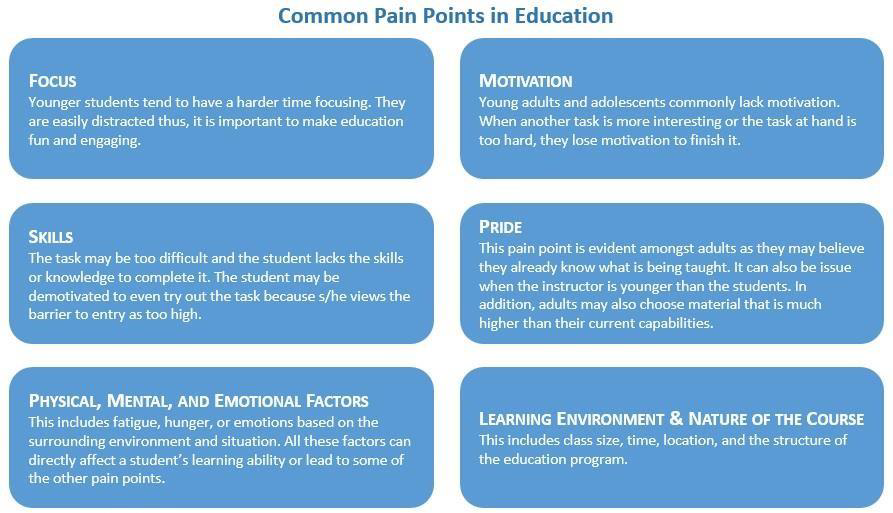
These questions help the instructor define the possible ‘pain points’ in the learning
program, and work around them.
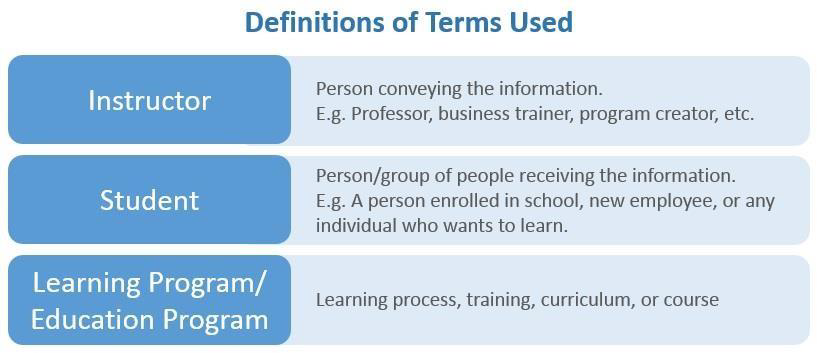
A pain point is defined as a factor that prevents a student from advancing through the learning program and/or achieving the objectives. Pain points can differ de- pending on the student’s age, background, or the field they are in. For example, the poor quality of assignments
being submitted, could be attributed to a number of pain points: the delivery method of the course (the student is a visual learner, while the course was deliv- ered orally), low motivation (as the assignment didn’t count towards the final grade), inability to balance office and course work, pro- crastination, etc.
Understanding these cause-effect relationships are key to determining the gamifica- tion elements (described in Step 5) that can be used in the design of the education program.
What is the duration of the learning program?
Where is the program being conducted? E.g. classroom, office, home, etc. Is it a group or a one-on-one setting?
If it’s a group setting, what is the group-size?
-
3.2 Step 2: Defining Learning Objectives
What does the instructor want the student to accomplish by completing the educa- tion program?
Every instructor should have an objective that s/he wants the student to achieve at the end of the learning program. This could include:
General Instructional Goals such as having the student complete an assignment, a test/quiz/exam, a project, etc. For example, Deloitte Learning Academy wanted to encourage employment training (Case Study 5.3)
Specific Learning Goals which could include the student understanding a concept, being able to perform a task after the training, or completing the learning program. For example, increasing consumer awareness and understanding of healthcare ben- efits and options with Healthcare University (Case Study 5.2), increasing an
individual’s knowledge of financial literacy through PlayMoolah (Case Study 5.4), or
increasing people’s knowledge of how their greener actions can impact the environ- ment for the better through Recyclebank (Case Study 5.5)
Behavioral Goals which may require the student to concentrate in class, complete assignments faster, minimize distractions in class, etc. For example, JFDI Academy’s objective was to increase the engagement of students (Case Study 5.1), Deloitte Learning Academy wanted to increase the engagement of the employees (Case Study 5.3), PlayMoolah’s objective is to encourage students to take action with their financial knowledge (Case Study 5.4), and Recyclebank’s objective is to empower people online and offline to make daily greener choices (Case Study 5.5)
While some learning programs can encompass several different objectives at once, the success of the education program is dependent on the ability of the instructor to
clearly define the learning objective/objectives that underlie the education pro- gram.
-
3.3 Step 3: Structuring the Experience
How can the learning program be broken down and what are the pain points?
Stages and milestones are powerful tools that enable instructors to sequence knowledge and quantify what the students need to learn and achieve by the end of each stage or milestone. These milestones work well for students as well, as it makes the ultimate objective seem more achievable and measurable, while ensuring that obstacles within and between each stage are easily identifiable.
Take for example, the Structuring of an Undergraduate Calculus Course:
Objective
Students must understand the concepts and be able to carry it forward to the subse- quent course
Stages/Milestones
Students must understand the concepts of Stage 1: Basic derivatives
Stage 2: Derivatives of polynomial and exponentials Stage 3: Integrals
Students who are unmotivated to push onto the next stage may be experiencing
fatigue or boredom. In this context, a push is defined as the motivation to advance from one stage to the next; i.e. what will keep the student interested or motivated to keep learning after completing a stage?
Students who have difficulty in completing a stage may lack the knowledge, or skills needed. In this context, complete is defined as the accomplishment of that
particular stage; i.e. what does the student need to understand or finish in a stage before moving onto the next one?
Complete: Trying to understand the concepts in each stage
Push: Motivation to go onto the next stage
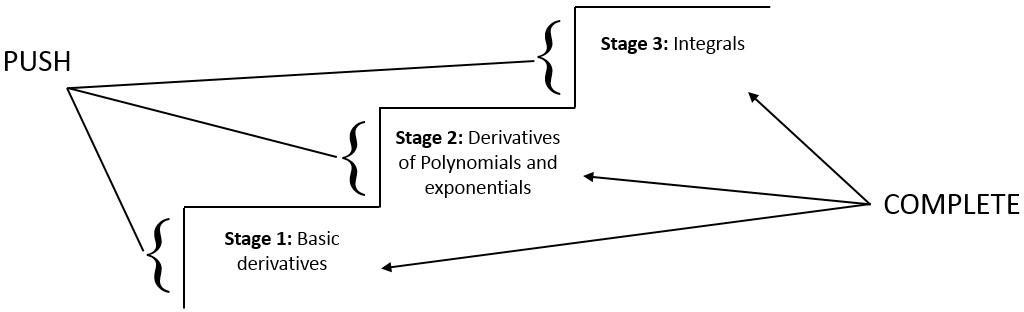
With each stage, the instructor may have different objectives. For example, in Stage 1, the objective is to thoroughly understand the concepts and establish a strong base, while in Stage 2 comprehension becomes easier, as a result of which the objective shifts to students completing their assignments faster and moving on to Stage 3. The
Complete: Trying to understand the concepts in each stage
Push: Motivation to go onto the next stage
context and pain points, may also vary in each stage - while the duration of each stage might affect some students, others might find a concept easier than others and get bored and lose motivation.
It is recommended that instructors start with easier milestones so that the student stays engaged and motivated. Also, breaking down the education program into different stages gives the instructor the opportunity to judge the objectives, context, and pain points, and prepare a more effective overall gamified process for education.
-
3.4 Step 4: Identifying Resources
What are the resources needed to gamify education?
Once the stages/milestones have been identified, the instructor can more easily judge which stages, if any, can be gamified, and how. Questions an instructor should think about while considering gamification include:
Can a tracking mechanism be applied to this specific stage?
What would be the currency and what determines the accomplishment of a level?
Are there clear rules that can be implemented?
Does the overall system give the student and/or instructor feedback?
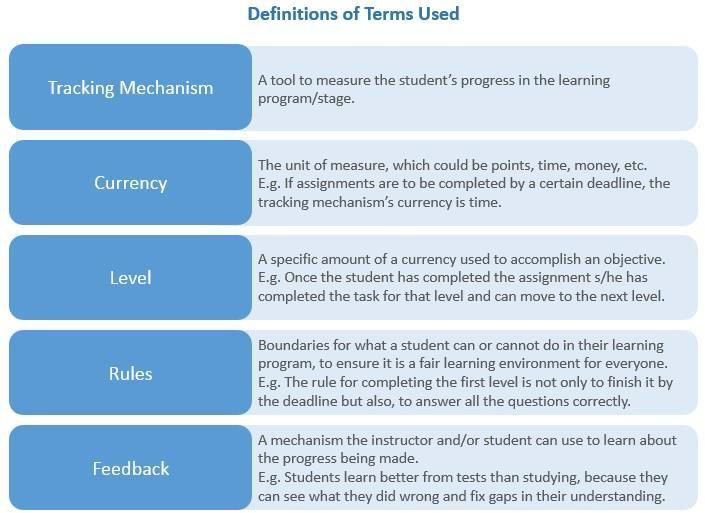
When designing the section being gamified, a currency can help determine levels within a stage and it is possible for a level to be a whole stage in the education program. It also gives the instructor the opportunity to use currency-based levels and rules to receive and give feedback. Feedback is an important ally, as studies show that students do better when given more opportunities to complete a task.9 This is exactly what makes games appealing, as students are given quick feedback if they do a task wrong and have the chance to try it again. Also, how much the student has completed by the given deadline can give the instructor feedback on their knowledge of the material and/or pain points.
Plants vs. Zombies was initially created by PopCap Games for PC and Mac computers in 2009, and is now a popular smartphone and/or Wi-Fi device game. The player is the homeowner, who has to use different plants to kill an army of zombies who are marching through his/her lawn to the front door.
The sequel, “Plants vs. Zombies 2: It’s About Time” released on August 15, 2013 and has taken its original game elements to a higher level. Tracking mechanisms in the game include a zombie meter within each stage, which indicates the number of zombies left to be killed in the stage. It also allows the collection of coins to purchase power-ups or additional games.
Before the start of each game, a quick comical narrative of the homeowner
indicates what the objectives and rules are for conquering that level. The zombie meter and these rules tell the player how close or far they are from completing the level.
The player is able to receive feedback quickly as they become aware of what a plant’s capabilities are, and what is needed to defeat a specific type/army of
zombies. If the player fails that level, s/he is able to try again and modify their game plan with learnings from the previous try.
Occasionally the player consistently fails a certain stage, indicating that the player needs to tackle a different stage and acquire a specific plant that will help them complete this stage. This continuous feedback allows the player to learn and adjust his/her strategies while moving through the different levels of the game.
-
3.5 Step 5: Applying Gamification Elements
What gamification elements should be applied?
The gamification process in education comes down to the elements that are applied to the learning program. As mentioned earlier, gamification is the addition of game-like-elements, also called game mechanics, in non-game settings. Game mechanics can be classified as self-elements or social-elements.
Using a specific type of element can trigger different reactions from students and when not used correctly, gamification may backfire on the instructor. For example, to complete a stage, a student may be required to acquire certain abilities and skills. However, if the stage is difficult, using a self-element may be more suitable as students may be intimidated by the task at hand when learning something new. Also if they are put into a community environment right away, they may become discouraged as they are constantly being compared to others.
For the push to continue to the next stage, it is important to ensure that the student is motivated to move to the next stage. Keeping other factors constant, social-elements can motivate students in a community setting. Consequently, if the learning program allows for students to participate at different times, it is best to have a leaderboard that refreshes on a regular basis. This encourages new students to partici- pate, and does not make them feel like they cannot catch up and lead.
Ultimately, it is the understanding of the context that surrounds the learning program, the overall objective, the specific objectives of each stage, if any, and the resources available, that allow game mechanics to be applied accurately, and with a higher probability of positive results.
Examples of Game Mechanics (Self-Elements vs. Social Elements) Self-Elements (Complete Stage) Social Elements (Push Stage) Points Leaderboards
Levels
Virtual Goods Trophies/Badges Interactive Cooperation
Virtual Goods
Storyline Storyline
Time Restrictions
Aesthetics
-
3.6 Recap
Instructors can go through these five steps of Gamifying Education to effectively im- plement gamification elements in learning programs and achieve different educa- tional objectives. Once the objectives are clear, the context will help determine the pain points. Breaking down the whole learning program into stages/milestones will make the analysis easier. For a stage to qualify for gamification, a currency- based tracking mechanism and rules are essential to develop levels and provide feedback on the student’s progress. Then, most importantly, either self or social- elements are applied where required, to gamify the education program. After the instructor has advanced through these steps, s/he will need to put it through a trial run, compare the results with the objectives and adjust the elements ac- cordingly. The accuracy and efficiency of applying gamification to the educa- tion program will depend on the thoroughness of implementing these steps.
3.7 Limitations and Discussion
EDUCAUSE pinpoints an important characteristic of gamification in its definition of gamification – the application of game elements in non-game settings. Instructors must remember that a game itself cannot be gamified and thus, if it is already a game, it is not a form of gamification. However, instructors can determine whether or not they want to add game elements to their education pro- gram or turn the complete learning program into a game to induce certain be- haviours in students.
Ben Leong, Assistant Professor at the School of Computing, National University of Singapore (NUS) states that there should be a clear understanding that gamification is independent of knowledge or skills. Gamification directly affects engagement and motivation and it indirectly leads to acquiring more knowledge and skills. Gamification encourages students to perform an action; for example, motivating students to practice computer programming will increase their skill and motivating students to memorize consistently can increase their knowledge.
Similarly, Michael Wu, Chief Scientist at Lithium Technologies emphasized that many instructors make the mistake of trying to gamify an outcome rather than behaviour. For example, one cannot gamify good grades but instead, can gamify the process for students to get good grades. Even when the objective deter- mined in Step 1 of gamifying education is a general instructional or specific learning goal, the instructor will be applying game elements to influence the stu- dent’s behavioural to achieve those objectives. For example, if the instructor hopes for the student to hand in assignments faster (outcome), a points ladder according to when the students hand in their work could be added as a game mechanic. This in turn can inspire them to develop a behaviour of doing their assignments ahead of time and thus, lead to achieving the original objective.
Instructors should note that gamification works best when the learning program is pure content and/or when the relevance of information is not immediately obvi- ous to the student. When gamifying an entire course, start with the information intensive areas first and allow the student to see the value in their learning pro- gram for continuous behaviour.
Lastly and most importantly, applying gamification strategies and/or technology to curriculums may often do a better job of teaching. However, it does not mean it should be a replacement for a comprehensive curriculum or face-to-face instruction. Instructors must be careful not to depend on extrinsic motivators in the game to modify student behaviour, as the habit created during the gamified process may not sustain once the extrinsic reward is gone. And finally, instructors must not disregard the importance of human teaching, because as Ben Leong states, “teaching is fundamentally a human activity.”
-
4. GAMIFICATION IN EDUCATION: CASE STUDIES
4.1 Undergraduate Education – JFDI Academy
An interview with Ben Leong, Assistant Professor at the School of Computing, National University of Singapore (NUS) and studying his publications provided insights into his creation of a game-like course called JFDI Academy. Through the application of game mechanics to a traditional scheme-based introductory programming course, it induced consistent behaviour from students and identified gaps in each student’s learning progress.
The overall objective of implementing game mechanics in the undergraduate course was to improve the engagement of students. The context surrounding course CS1101S was that it was offered only in the Fall semester, over a 13 weeks period, and with one midterm. The class size was noticeably smaller with only 50 to 60 students and required 3 hours of lecture, a 1-hour recitation, and a 2-hour tutorial per week. The small size of the class allowed for experimentation and implementation of such a program. Students who normally enroll in this alternative course are generally more motivated and students looking for advanced level courses in the subject. Furthermore, the completion of this course would prepare students for the subsequent course later in the program. Several pain points identified by Professor Leong prior to implementing JFDI Academy included:
Students tend to procrastinate and start on their problem sets only two or three days before the deadline.
7 problem sets for the module and each typically took 10 to 30 hours to finish. Optional problems sets were often ignored.
Feedback was not provided in a timely manner – typically graded as a batch only after the due date.
Students often had difficulty identifying key concepts taught in lectures; especially if the concepts learned are not applied right after they are taught, students have difficulty recalling it.
JFDI Academy was able to tackle these problems by structuring the education program and adjusting the curriculum. This included breaking down the problem sets into 22 assignments, and providing bonus questions and a ‘path system’ to reinforce lectures. Note: An instructor must have the monetary and skill-related resources to implement a program like this. In this case, Ben Leong worked with a team of programmers from MIT and Facebook, and designers, to create an aes- thetically appealing and feasible system to track all the points, feedback and leaderboards.
The online curriculum was able to provide students with timely feedback.
A specific function was autograding, in which once a student submitted the answer to a question, s/he was automatically given feedback on whether it was correct or not. Through the auto-grading system, instructors were also able to receive feedback on a student’s progress by seeing how many times a student tried a question, what they did wrong, and the average time per assignment. Another aspect of the program was that assignments were graded within 24 hours of sub- mission. Students also had the opportunity to raise questions or concerns regard- ing the assignment, by posting comments on Facebook or the program, which enabled instructors to help them in a timely manner.
Elements added to JFDI Academy included basic game mechanics such as ‘experience points’, which allowed students to level up and compete on a leader- board with other students. It also had a developed storyline, where the assign- ments were called ‘missions’, bonus questions were labeled ‘side quests’, and class participation and attendance all fell under a ‘Star Wars’-based universe. It was narrated from a third-person perspective and comic strips started each mis- sion. To avoid a potential drawback of implementing gamification, which in this case was embarrassment for the weaker students, the leaderboard only displayed the Top 15 students.
The game-like curriculum showed impressive results with pain points being identified and tackled, and specific gamification strategies being implemented by Ben Leong and his team. 76% of 51 students found the system to be helpful in their learning and the ‘mission feeds’ improved interactions with the teaching staff. Motivation improved with 71% agreeing that the self-element of leveling up encouraged them to finish their assignments, while 33% were motivated by the social-element of the leader board and achievements. Submission times for assignments also improved drastically, with submissions moving from less than one day before the deadline to more than 2 days before the deadline. Finally, a mid semester survey that usually took one and half weeks to be completed by students, was all done in 3 days by tying in experience points to its completion.
This system also allowed instructors to easily compare student results with original objectives and understand where adjustments to the game or the course were necessary. For example, Ben Leong found that some students were overwhelmed by the number of deadlines, a result of the curriculum being broken down into 22 missions.
These gamification strategies implemented in an undergraduate course show that when done properly, both the instructor and the student can effectively benefit from gamifying education.
4.2 Consumer Education – Healthcare University
Gamification is a commonly used marketing strategy used to engage consumers with a brand and increase brand recognition. However, using gamification to educate consumers about a product prepurchase and/or post-purchase is still a developing strategy.
Understanding health insurance can be quite overwhelming for many people. The terms, the details, and the small print often confuse consumers and demotivates them from learning more. With so many benefits offered, each with different levels of complexity, it is difficult for consumers to easily understand the healthcare market on their own. In the United States, less than 20% of employees understand their healthcare benefits, and with the current reforms in the healthcare sector, it is imperative that consumers are aware of what products are available to them and the price variations.
Launched in February 2013, Healthcare University was created by Capital Blue- Cross with the objective of using gamification to teach consumers the basics of healthcare and how to make value-based healthcare decisions. Healthcare University aims to simplify the process and encourage these consumers to learn and take action. The education program is structured as: watch a video, take a quiz, and play a game. The first 4 topics10 to be learned are structured as:
The videos average around 3 minutes each and then the student can take a pop quiz to refresh his or her understanding of the information conveyed. A challenge is then introduced by allowing the student to take what they have learned and play it in a game setting. When the student has managed to achieve 100% on the game, they are encouraged to move onto the next topic. Even if the stu- dent does not receive 100%, s/he is still allowed to move on but is not prompted to do so right away.
Each topic has a different game for the student to play. This strategy inspires/encourages a student to complete the topic and move onto the next topic as they are now anticipating the next game. Apart from watching the video, students can also choose to read about the topic from a PDF file that clearly lays out the information with key terms and a pop quiz included on the last two pages. When a student masters all courses within a subject, they win a badge. Students earn points as they go through the education program, and compete with other students on the leader board. By executing basic gamification elements, both self and social, Healthcare University allows education to be fun, engaging and effective for consumers.
Capital BlueCross initially implemented the program for its own employees, with a target of 20% to get on board. The launch of the program resulted in registra- tion rates reaching 90%, with an average of 8 courses completed per student. In addition, 62% of students who completed one course continued to complete all 10 courses. Based on this success rate, it is evident that Healthcare University has created a simple and effective way for people to understand the basics of sav- ing on their healthcare choices.
4.3 Corporate Training Education – Deloitte Leadership Academy
According to Gallup’s Employee Engagement 2011 results, 71% of workers were “not engaged” or “actively disengaged” in their work, and a lot of money and effort is spent on training material that often goes unused. Furthermore, employees tend to have low interest in corporate training because of the incurred costs of time and money. “Let’s face it. For most people, on a typical Sunday morning, if given the choice between ‘Am I gonna watch ESPN, or am I gonna do some training?’ training will not win,” says James Sanders, Manager of Innovation at Deloitte Consulting.11 Thus, to drive stickiness to corporate training, Deloitte successfully applied one of the most common gamification mechanics – points and badges – to its digital executive training program, Deloitte Leadership Academy (DLA).
Deloitte’s objective was to encourage corporate training among executives and increase their engagement – both a general instructional goal and a behavioural goal. With nearly 200,000 Deloitte employees and more than 50 client companies expected to do corporate training, the student size is quite large, which
meant that a gamification application to the training would have to cater to such a large group. Also, as the students were experienced executives, the important pain points to be addressed were that the students had limited time to spare and the course itself had to be of high educational value.
The gamification element they chose, was a points and badge system that was added to their digital training program when Deloitte partnered with Badgeville in 2012. Having identified the context surrounding the program, this element better suited a large group of students who had limited time to learn. The content for the training covered lessons from Harvard Business Publishing, Stanford Gradu- ate School of Business, Melbourne Business School and IMD, and included leadership training classes to deal with situations of high complexity, teams and environmental change.
The program was structured as a 12-month study program tailored specifically for the student by focusing on 12 competencies s/he needs to improve on. By limiting the length of each lesson from 10 minutes to an hour, it allowed the employees to easily access and complete trainings in their spare time at the office, or while commuting. Deloitte also took into account specific functions of the gamified training to enhance motivation for its students. For example, many executives who travel on the job and couldn’t commit to a week of training. To cater to this, the leader board was reset every week to offer a balanced system, encouraging executives to jump on the training during any week. Ownership was also given to the employees by customizing their learning program and priorities. In addition to this, individuals were ranked amongst the ten that were most competitive with themselves, rather than on a Top 10 overall list.
These applications of gamification took into consideration the limitations and counterproductive effects; allowing executives to have a sense of accomplish- ment as they completed the learning programs at their own pace while sharing knowledge with other coworkers. The complete program helps students to complete a lesson and pushed them to learn other lessons.
As a result, Deloitte experienced a 37% increase in the number of returning users to their digital learning portal, an increase in the completion of the programs and a 40% increase in weekly visitors12
4.4 Financial Literacy Education – PlayMoolah
According to Stanford University graduates, Min Xuan Lee and Audrey Tan, the root of the 2008 financial crisis was caused by the low level of people’s under- standing and utilization of financial literacy. In April 2012, Lee and Tan captured this issue and launched PlayMoolah, a financial literacy program catered to- wards children and young adults. With PlayMoolah, the founders’ objective was to encourage people to take action with their understanding of financial con- cepts – a behavioral goal of financial literacy.
Targeted at children in the 6+ age group, PlayMoolah is presented on an online platform, and allows them to play the game via any internet access. As younger students lose fo- cus easily, the pain points in teaching them financial literacy is that they have to find it interesting. Also, it had to be easy to navigate through the program, so that they could teach themselves, while parents monitored and guided their progress.
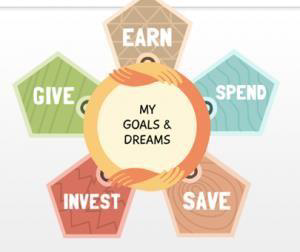
The learning curriculum in PlayMoo- lah is structured in a way that the stu-
dent can interchangeably learn the different aspects of: earn, spend, save, in- vest and give on a Dream-verse world. Students create an avatar called a Mini for themselves and are able to decorate their own planets with homes and other Minis. For example, the game starts off by teaching the student how to earn Moops by feeding Minis (earn) and then shows them how they then buy homes for the Minis (spend). For the saving aspect, it shows the user how to set a goal and gives examples of goals that other users are saving for in the ‘goal ma- chine’. The user is asked to input the following information when setting a goal:
Parents are informed when the child achieves a goal set for her/himself, and can
give the child real world cash rewards in exchange for Moops. As the students want to earn more Moops or spend to build their planet for the Minis, they have to navigate through the five options. To tap into the Invest and Give aspects, the student’s parents have to pay for a membership where students can invest their
Moops or donate it to real-world charities. Other perks that come with the mem- bership include more levels, items, and other parts of the program. Students can also unlock new items and challenges by leveling up through accumulating Moops.
The program has one main tracking mechanism which is enforced by its currency (Moops), which can be tracked by a counter on the top left of the student’s screen. In addition to this, the program informs the students of their cash flow after each earning activity, which in turn provides feedback on their financial decisions. When the student sets up his or her own goal by inputting the cost of the item and how much they want to save each day, the program automatically calculates how many days it will take for them to reach their goal. Then each day it tracks how much the student plans to save and how much closer s/he is to the goal.
Moops as points, leveling up, and appealing aesthetics are some of the self-elments PlayMoolah uses, while inviting other users to see their planet, and making friends, integrates the community aspect into the program. Under the aspect of ‘earn’, students are also allowed to play a variety of games related to money and numbers called ‘Spin and Guess’. Each game allows the user to see his or her own personal best scores and compete against other users on a global leader board. Through a combination of self and social elements, PlayMoolah allows students to understand and experience the effects of financial decisions in the safety of a digital world but with real-world rewards.
Results have shown that the program has resulted in students completing more tasks, such as chores, given by their parents. Parents can also track how their child’s behaviour has changed through the program, and use information received through email updates to reward them and encourage them to stay committed to their tasks. The future of PlayMoolah is directed towards several banks that are interested in implementing the program for their customers.
OCBC Bank, one of Singapore’s largest banks, partnered with PlayMoolah in November 2012, and within the initial 3-month period, 78% of children wanted to in- crease their savings with OCBC and 55% felt that “learning to save money” was the most important takeaway.13
From this, it is evident that PlayMoolah is not just a game but a gamified way to nudge students to get involved in the financial aspects of life. A nudge that effectively achieves Lee and Tan’s initial behavioural objective.
4.5 Social Responsibility Education – Recyclebank
Although people may agree that it is important to recycle, they don’t often see a tangible value that can motivate them to take action. Some of the pain points that prevent individuals from recycling include, the demand on their time, and the inconvenience of having to recycle.
Recyclebank was launched in 2004 to tackle just these issues. In addition to increasing recycling rates, the company also aims to empower people online and offline, to make smarter transportation choices, adopt a greener lifestyle, and minimise the use of energy and water.
With a flexible learning program structure, Recyclebank encourages new visitors to try out the rewards program by navigating through three pledges to collect points. Through this, it conveys a few educational points on “how to help the planet” through purchasing decisions, as well as tips on recycling. It also encourages the visitor to sign up on the website and see where they rank among their friends. Once registered, members can earn points on their own time by learning, reading, pledging to take action, making greener purchases, or using fewer resources.
The currency-based tracking mechanism is a points system, and levels and rules are determined by the rewards that the individual is able to redeem with the points. For example, when the visitor commits to three pledges, s/he receives 30 points which s/he can choose to redeem for discounts
coupons for retail stores or products. Points are tracked on the top right corner of every landing page, allowing students to easily receive feedback on their points and eligibility for rewards. At the top of the page, Recycle bank also directly displays its impact, by providing feedback on the total number of members, pounds recycled, and points earned. In addition to this, individuals are also able to compare their actions to others in the Recycle bank ecosystem.
These self-elements (points system and rewards) and social-elements (competition through a leader board) have allowed Recycle bank to successfully tackle the challenge many people face in creating a greener environment. Currently, Recycle bank has over 4.5 million members, who have recycled over 3.7 billion pounds of materials. There have also been some unique initiatives, such as partnering with Google on the Green Your Home Challenge, which resulted in 49,000 participants of which 97% said the game increased their knowledge on green living and also had over half of existing and new members willing to take green actions. Recycle bank confirms that utilizing game mechanics in social responsibility education is an effective way to educate consumers and encourage them to take on greater responsibility.

-
5. Conclusion
In a traditional learning environment, a student’s motivation to learn effectively can be hindered due to a number of reasons. However, with the successful application of suitable gamification techniques, the delivery of the information can transform a simple or mundane task into an addictive learning process for the students.
While the underlying objective of applying gamification to any education pro- gram is to prompt some type of behavioural change in the student, many in- structors specifically look to tackle the issue of student motivation and engage- ment during their learning process.
For students, gamification serves the purpose of minimising negative emotions that they usually encounter in traditional forms of education. It lets them approach knowledge and skills, using the learn-by-failure technique that is popular in game-like environments, without the embarrassment factor that usually forms a part of classroom education. Instructors on their part can efficiently achieve their set objectives and use currency-based tracking mechanisms to get feed- back on their students’ progress.
Though it is not easy to successfully implement gamification in education, a mindful approach using the five steps laid out in this report, can increase the probability of creating an effective education gamification strategy. It is also recommended that instructors remember that gamifying education may require long periods of fine-tuning and most definitely should not replace the original value of human teaching. Gamification in education can be a powerful strategy when implemented properly, as it can enhance an education program, and achieve learning objectives by influencing the behaviour of students.
References
1 Richtel, M. (2010, November 21). Growing Up Digital, Wired for Distraction. Re- trieved from The New York Times: http://www.nytimes.com/2010/11/21/technology/21brain.html?pagewanted=all&_r=2&
2 Lloyd, K. (n.d.). Evaluating the Effectiveness of an Employee-Training Program. Retrieved from For Dummies: http://www.dummies.com/how-to/content/evalu- ating-the-
effectiveness-of-an-employeetrainin.html
3 Silberman, J. (2013, May 1). How to Measure Employee Training Effectiveness? Retrieved from Training Station: http://trainingstation.walkme.com/how-to-measure-employee-training-effectiveness/
4 Volkswagen. (2009). The Fun Theory. Retrieved from Thefuntheory.com: http://www.thefuntheory.com/
5 Bates, C. (2009, October 11). Scaling new heights: Piano stairway encourages commuters to ditch the escalators. Retrieved from Daily Mail Online: http://www.dailymail.co.uk/sciencetech/article-1218944/Scaling-new-heights- Piano-stairway-encourages-commuters-ditch-escalators.html
6 Association, E. S. (2013). Essential Facts About the Computer and Video Game Industry. Retrieved from Entertainment Software Association: http://www.theesa.com/facts/pdfs/ESA_EF_2013.pdf
7 TED. (2010, March 17). Jane McGonigal: Gaming can make a better world. Re- trieved from http://www.youtube.com/watch?v=dE1DuBesGYM
8 Wang, R. (2011, December 6). Demystifying Enterprise Gamification for Business. Retrieved from Constellation Research.
9 Evans, C. (2011, July 31). Game designer Jane McGonigal interviewed by Cameron Evans, U.S. Education CTO, Microsoft. (J. McGonigal, Interviewer) Re- trieved from http://www.youtube.com/watch?v=5-mc9Rrfs00
10 Capital BlueCross. (2013). Healthcare University. Retrieved from Capital Blue- Cross: https://www.capbluecross.com/wps/wcm/connect/CBC-Pub- lic/CBC/HealthCareReform/youAndReform/healthcareuniversity
11 Meister, J. C. (2013, January 2). How Deloitte Made Learning a Game. Re- trieved from HBR Blog Network: http://blogs.hbr.org/cs/2013/01/how_deloitte_made_learning_a_g.html
12 Robb, D. (2012). Let the games begin. HRMagazine, 57(9), 93-94,96-97. Re- trieved from http://search.proquest.com/docview/1039492375?ac- countid=14771
13 PlayMoolah. (n.d.). PlayMoolah in Action: Proven In-Market Success. Retrieved from PlayMoolah: http://www.playmoolah.com/b2b.html
 Create Future Gaming 2023-1-ES01-KA210-SCH-000150686